How do young people nurture the inner resources that help them navigate challenges and connect with others? citiesRISE is exploring how gratitude, kindness, and hope can be cultivated in young people through arts-based, peer-led practice.
citiesRISE is a global platform committed to transforming mental health outcomes for young people by nurturing innate capacities – inner cultivation, relational engagement, and engaged action.
With support from Templeton World Charity Foundation (TWCF), the organization developed and tested weRISE, an arts-based, peer-led intervention focused on Gratitude, Kindness, and Hope for youth ages 12-15 in India and Kenya.
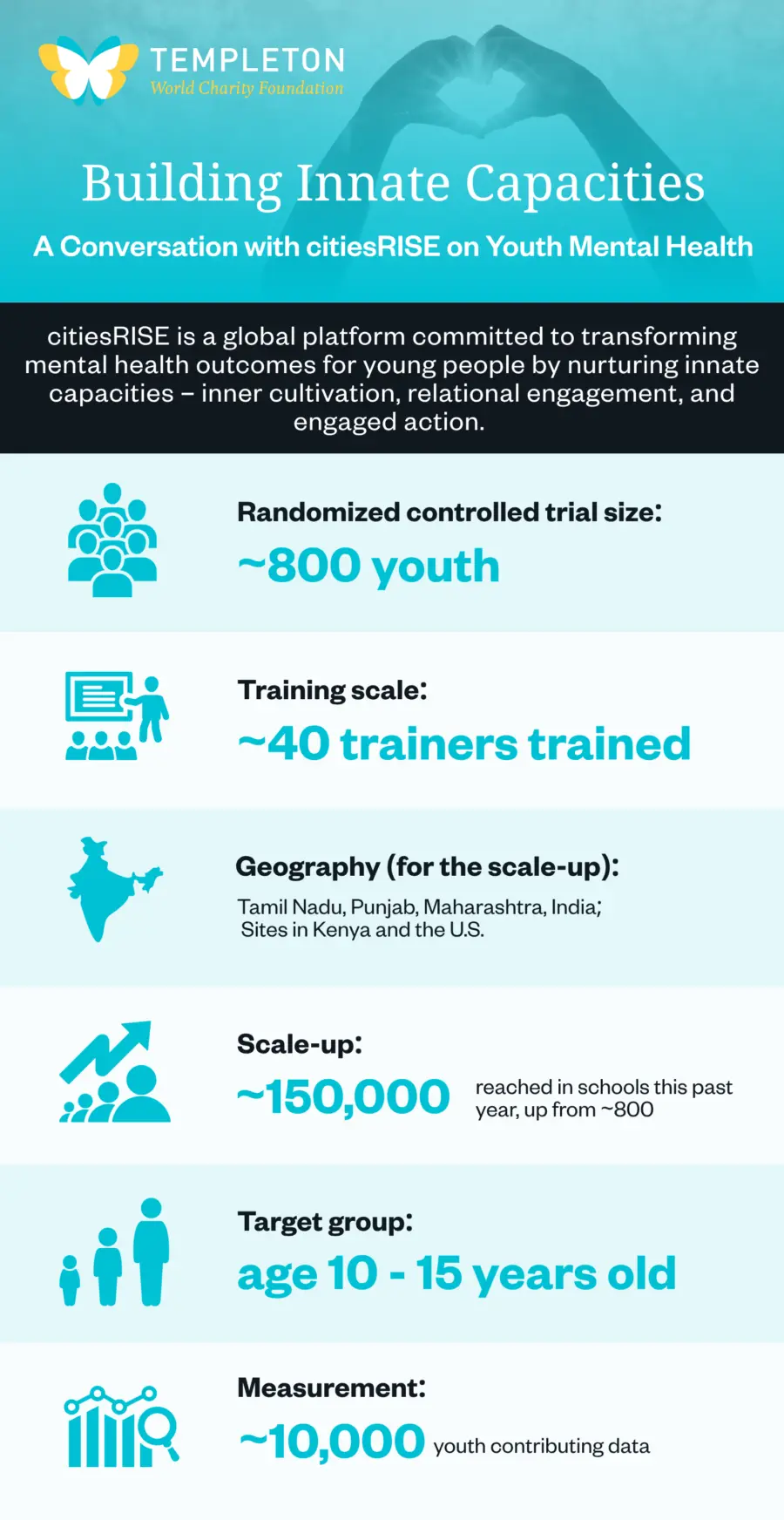
Through a randomized controlled trial with nearly 800 participants, the citiesRISE team gathered evidence that the approach builds core capacities in young people through storytelling and arts-based practices, as well as resonates across cultures, particularly with youth from under-resourced communities.
Matt Hughsam, who leads research and innovation at citiesRISE as Senior Director of Strategic Initiatives, and Dr. Shahab Ali Siddiqui, Director for Programs and Partnerships, spoke with TWCF about their work.
Matt opened the conversation with a clear sense of purpose. “We’re a multi-stakeholder initiative committed to improving young people’s mental health and wellbeing around the world through inner development,” he said. It’s a mission statement that immediately signals something different from conventional mental health approaches – a focus not just on treating problems, but on cultivating the inner resources that help young people flourish.
What does that actually mean in practice? “The weRISE intervention uses gratitude, kindness and hope through arts and school and community settings...in a randomized controlled trial across India and Kenya,” said Matt. The approach employed “a combination of modern science, ancient wisdom and experiential learning” to demonstrate that capacities for inner cultivation, relational connection and engaged action are foundational to mental health and wellbeing.
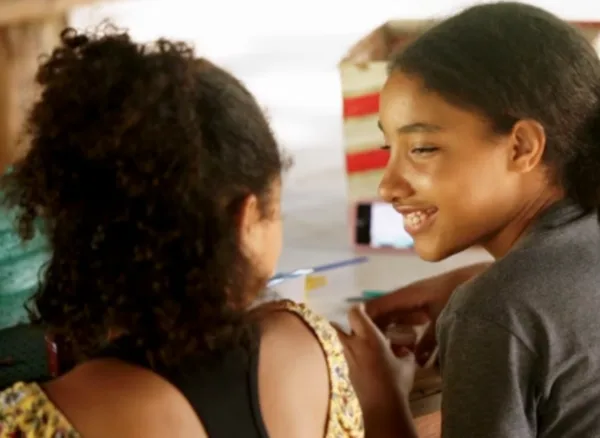
That particular phrase – inner cultivation – threaded throughout the conversation, highlighting something the citiesRISE team believes is often missing from youth mental health efforts: attention to the inner capacities that help young people navigate challenges, build meaningful relationships and engage positively with the world around them. weRISE delivers these not through lectures or clinical interventions, but through theater, storytelling and creative expression, enabling young people to experience and practice gratitude, kindness and hope in ways that stick.
The project focuses on a specific age group, Matt explained. “Twelve to fifteen years is the really key period of development where young people are starting to take more risks, their identities starting to form. And this is where you can start to really work on the types of mechanisms young people have in their lives.” It’s also a window when trajectories can shift “toward transcendence and improving development throughout the life course, [or toward] negative risk behaviors and a different life trajectory.” weRISE aims to intervene at exactly this inflection point, before patterns become entrenched and directions become more difficult to change.
Dr. Shahab Ali Siddiqui joined the conversation to share what the team learned from the trial. The numbers were significant: “It was done with nearly 800 youth and we trained around 40 trainers on art-based practices,” said Dr. Siddiqui. “And the learning is that the youth have found core capacities being built up because of...storytelling and art-based practices.
The delivery model itself is integral to the program. Young trainers aged 18-21 are equipped to deliver the curriculum to even younger participants, expanding reach while developing leadership capacity in the trainers themselves, and creating a peer-to-peer dynamic that builds credibility and connection.
When asked about scale-up potential, Dr. Siddiqui was optimistic. “This project has great potential for scale-up because it was a randomized controlled trial [that we were able to] test against an established practice being delivered in both India and Kenya.” The key is the methodological rigor. By comparing weRISE to an existing mental health literacy program, the team was able to demonstrate the approach added meaningful value while highlighting many “positive things about the inner development and inner cultivation in youth that resonates with societies across the globe, especially ones with underprivileged backgrounds.”
Some of the most compelling evidence, however, came not from the trial data but from conversations with participants themselves. Dr. Siddiqui described a recent convening in India where the team connected online with young people who had gone through the program or been involved as peer facilitators. They asked questions about core capacities, how the training had affected them and how they were applying what they’d learned. “This was a group of students aged between 12 to 18,” said Dr. Siddiqui. “And they said that we are now understanding that there is a route to our own inner being.”
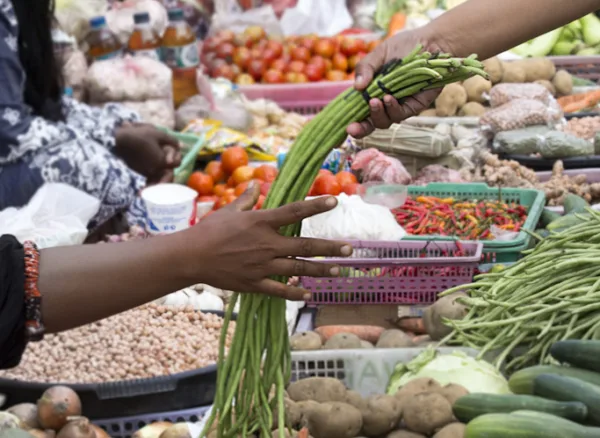
That feedback, “a route to our own inner being,” captures an essential element of what weRISE is trying to accomplish. These are not young people who have been taught facts about mental health. These are young people who have been given practices that open up new ways to relate to themselves and to the world around them. In the end, the arts-based methods resonate particularly deeply. “The practices which we inculcated in them through art-based and drama-based and theater-based activities, they were very curious about those activities and found it very interesting to practice in their daily lives,” said Dr. Siddiqui. He shared the example of gratitude at mealtimes, which really stuck with him. “Once they start having their meal and then thinking about what they are eating and where it comes from, it [seemed to] fill them with lots of gratitude towards what they were receiving.”
These small shifts – pausing before a meal, reflecting on where food comes from, noticing what you have rather than what you lack – might seem modest, but they represent exactly what weRISE is designed to cultivate: habits of attention and appreciation that young people can carry with them anywhere, and practices that require no special resources or clinical access, just a willingness to notice and reflect.
For Matt, the partnership with Templeton World Charity Foundation has been especially moving given how central inner development, spirituality and human flourishing are to the Foundation’s mission. “In global public health, you don’t always get the question of what is the importance of spirituality, what is the importance of inner development, what is the importance of human flourishing,” he said. “Whereas the Templeton World Charity Foundation, it’s really refreshing to work with a funder where this is really central to what they do and they sort of really come behind the mission.” This shared commitment has allowed citiesRISE to ask questions that might otherwise have gone unexplored in traditional public health research, and to gather rigorous evidence that inner capacities like gratitude, kindness and hope are not just nice ideas, but measurable, teachable foundations for young people’s mental health and wellbeing. The participants in India and Kenya are proof of concept: young people who, through art and practice and reflection, discovered a route to their own inner being.
Since the video interview was recorded, the TWCF-funded work has evolved significantly. The intervention has been reframed as the “Core Capacities” approach, built on the idea that every young person, across cultures and contexts, has three core capacities that need support: capacity for inner cultivation, relational capacity, and capacity for engaged action. Gratitude, kindness and hope remain central, alongside the recognition that every young person has signature strengths to draw upon.
The scale of impact has grown dramatically. Working with three implementation partners across Tamil Nadu, Punjab and Maharashtra, citiesRISE has been able to reach around 150,000 young people in schools this past year, a significant increase from the original trial of 800. The work has also expanded to include interventions for teachers and whole school environments, focused on creating cultures of belonging.
New pilots are testing the Core Capacities approach in different contexts: Firpi Family, a game-based intervention for parents and children to practice together at home; a Youth Fellowship for 18-30 year olds across India, Kenya and the United States that mobilizes young people to run service projects in their communities; and Clinic to Community, which supports mental health professionals to integrate inner development practices into their work with young people.
The team has also developed new tools for broader adoption: a tailored measurement instrument for core capacities, a practices library (with a vision to become an open-source, community-curated resource), and a technology platform for collecting data at scale. This year, 10,000+ young people are contributing data, and the team is experimenting with machine learning methods to understand which practices work for whom in which contexts. The aspiration is that as more organizations use these tools, the collective understanding of what supports young people’s inner development will deepen and turn proof of concept into proof at scale.