Racquel Moses, CEO of the Caribbean Climate-Smart Accelerator discusses the Climate Smart Map, a platform designed to track impacts, surface solutions, and connect projects to capital.
The Climate Smart Map was built to make the Caribbean legible at regional scale — linking climate impacts, economic context, and project pipelines in one place. Hurricane Melissa made plain why that visibility matters. In the storm’s aftermath, Caribbean Climate-Smart Accelerator (CCSA) used the platform to quantify losses and compare them with the resources currently available for recovery revealing a stark financing gap.
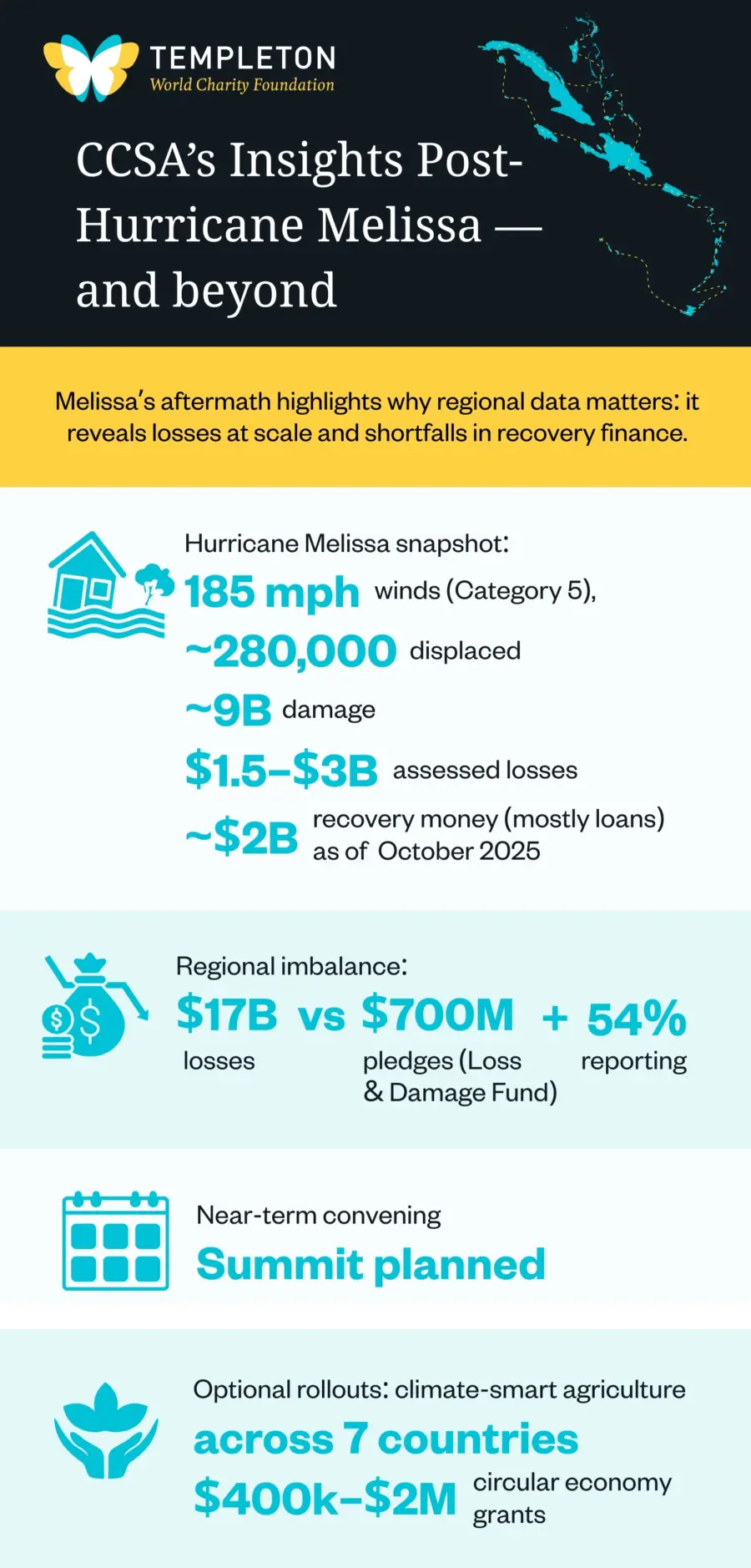
Tragically, Hurricane Melissa's recent devastation highlighted how high the stakes are for the region. When the Category 5 storm struck Jamaica on October 28, 2025, it arrived with 185-mile-per-hour winds, the strongest ever to hit the island. And though Jamaica had done everything right – from maintaining fiscal discipline and arranging catastrophe bonds to investing in infrastructure, all of which resulted in a credit rating upgrade in September – none of it was enough. All told, some 280,000 people were displaced and nearly $9 billion in damage was inflicted. Despite years building its climate resilience, the damage was overwhelming.
"Jamaica is facing somewhere between $1.5 to $3 billion in assessed losses so far," said Racquel Moses, CEO of CCSA. "It probably has access to about $2 billion in recovery money, but most of that will be [in the form of] loans, which will affect their debt-to-GDP ratio and certainly lower their resilience. And this isn't where it ends. There's a hurricane season happening next year."
When CCSA analyzed its data in the aftermath of Melissa, the imbalance was stark. Despite only 54 percent of Caribbean nations even reporting, the region has thus far incurred $17 billion in climate-related losses – against a mere $700 million in pledges via the global Loss and Damage Fund. "Any one Caribbean nation's loss would have absorbed the entire fund," said Moses. "It's just really difficult to see how we even get this fund to a point where it makes any difference at all."
Just weeks after Hurricane Melissa, Moses spoke at COP30 in Brazil to make the case directly to world leaders. "It will be much, much harder to ignore the Caribbean now," she said. "The very way that we live is dependent on these negotiations going according to plan." Though final figures have yet to be announced, the timing sharpened global attention and Jamaica was able to raise new resources through its participation at the conference.
And things continue to evolve. Countries can now enter their own data directly onto the platform through a crowdsourcing approach that will help keep information current and ensure data provided by trusted sources like the IMF and World Bank is up-to-date. CCSA is planning a Climate Smart Map Summit in late Q1 or early Q2 (2026) to walk policymakers through the process. "We'll let them know that we will vet and verify all of the data so they're not nervous about putting information out there," said Moses, adding that they will also offer tutorials to help build confidence in both using and contributing to the platform.
In terms of what to expect in the near future, Moses confirmed a new visual identifier is in development, designed to show project readiness stages at a glance. Investors had noted that some listed projects were too early in development for commercial funding, and asked for clearer indicators to help distinguish between initiatives that are investment-ready or even post-revenue and those still taking shape.
"This could help attract investors who are willing to take a risk pre-bankability," said Moses. "And it helps philanthropy understand where they can make a difference [in helping to bridge the gap]."
CCSA is exploring a tiered “fee-based” access model for the platform. While usage has been growing as hoped, Moses said the team will wait for strong use cases to emerge before introducing any paid features. "We really think it's important for research, for matchmaking, for building resilience across the region," she explained. "We want to develop that potential before we create any barriers." The platform will remain free for students, investors and the public sector; any paid model would apply only to a limited set of private sector listings.
Meanwhile, in Jamaica, CCSA is already in discussions with the government to list reconstruction projects as they are put together, creating a pipeline for matching communities in need with funders ready to support resilient rebuilding. Traffic to the platform spiked following Hurricane Melissa, indicating a rising interest in this innovative tool that offers strategic clarity in the aftermath of a devastating event.
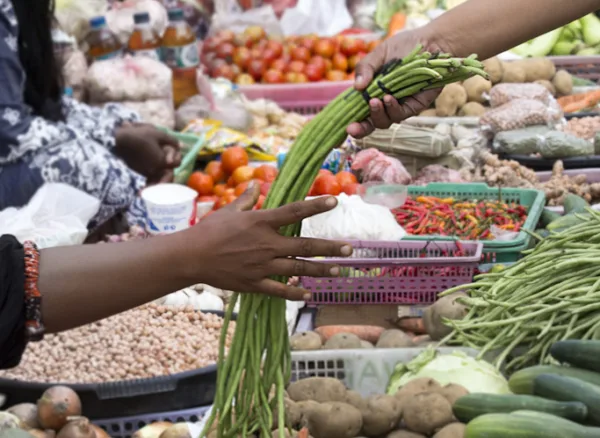
For now, Moses is committed to reframing how the world sees the Caribbean and highlighting local innovation, and is keen to promote the three specific categories of projects:
"These are all solutions being led by the Global South," said Moses. "Our belief is, why can't it start in the Caribbean and then proliferate?"
For Moses, the Climate Smart Map has the potential to be a blue-printable tool that could serve as a model well beyond the region — for example, the Indian Ocean basin and other climate-vulnerable areas. Scaling the model, however, requires institutional backing. "Why can't we have more global solutions, including our climate smart map, being funded by major philanthropy to live and breathe and build capacity in the Caribbean?" With the right support, Moses is confident the platform could evolve into a global decision-support framework rooted in data transparency and south-south knowledge exchange.
Alongside its continued development, CCSA is also preparing to release a comprehensive report examining the solutions and actors required to close the gap between where the Caribbean is and where it needs to be; a data-driven roadmap for building regional resilience. "Looking at solving problems through the lens of data is really exciting," said Moses. "We're really looking forward to having people work with us on creating solutions."
Those who want to support Caribbean climate resilience can explore the platform and pull data, review project listings or simply reach out with recommendations. "We would love more of that kind of energy and co-creation," Moses said, adding that spreading the word helps as well – amplifying the region's leadership can shift narratives that have long focused solely on hardship and failure.
Anyone wanting to donate to help expand the platform or support pipeline projects can do so through the site or via CCSA's GlobalGiving page.
"The support we received from Templeton and the coordination with people from Templeton has been unlike very many of our other experiences," said Moses. "We were so grateful for this level of collaboration — asking great questions, providing us with guidance, and also just being excited along this journey of discovery for us.
"At the end of every day, we are grateful to be able to do this work. And excited about the innovation coming out of the region."
For the Caribbean, this platform is almost a mission statement about data's ability to drive change, that small nations can lead, and that a region often overlooked might just be a catalyst for global resilience.
View The Related TWCF-Funded Project: Caribbean Smart Climate Map
See Part 1 for A video interview with Racquel Moses on how the map works.