How we can overcome the feelings of moral outrage that so often divide us? Dr. Kurt Gray explores the roots of political polarization and paths to common ground in this episode of Stories of Impact podcast.
Dr. Kurt Gray believes that understanding our shared concern for harm may be the key to bridging divides and building the foundation for human flourishing.
A professor of moral psychology and neuroscience at UNC Chapel Hill, Gray directs the Deepest Beliefs Lab and leads a research project supported by Templeton World Charity Foundation.
He joins this episode of the Stories of Impact podcast to discuss his work examining how perceptions of harm and vulnerability drive deep moral and political divisions further detailed in his book Outraged: Why We Fight About Morality and Politics and How To Find Common Ground.
Listen with the below player
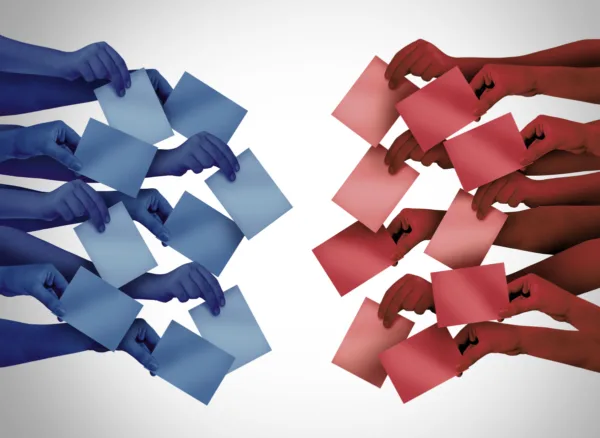
We often assume that polarization is a battle between opposing values, but Gray’s research suggests that it’s more accurately a battle between differing perceptions of vulnerability. Across issues like abortion, immigration, and healthcare, “our moral judgments hinge on our perceptions of harm and vulnerability,” says Gray. “We all agree that kicking a cat or abusing a child is wrong. The disagreement starts when we ask: Who else is vulnerable?”
Gray’s experiments show that liberals and conservatives are motivated by the same moral instinct — to protect the vulnerable — but differ in who they perceive as being harmed. “Liberals see folks like trans and gender-nonconforming folks, Muslims, maybe poor African Americans… as vulnerable,” he says, “whereas many conservatives see everyone as more or less equal when it comes to their vulnerability.”
This divergence can be traced back not just to culture, but to evolution. Gray explains that our moral instincts evolved during times when humans were more prey than predator. “For most of those millions of years, we were more hunted than hunter,” he says. This evolutionary lens reveals that our minds are wired to scan constantly for threats, making modern humans particularly susceptible to outrage in response to perceived harm.
And in today’s media environment, those instincts are weaponized. Gray points out that social media platforms amplify outrage by highlighting threats and prioritizing emotionally charged content. “Moral condemnation ultimately comes from concerns about harm,” he notes, and those concerns get heightened by online echo chambers. “You log in and you see screaming people running toward you and the sound of distant roars, like a Godzilla movie,” he shares.
Yet, Gray's research also points storytelling as a powerful antidote. His lab conducted experiments in which people were invited to talk across political differences through personal experience. The results were clear: “Rather than facts, what helps people connect across differences are sharing personal experiences.” These conversations were significantly more respectful, and participants who shared stories were perceived as more rational and credible. “We found that when people talked about their own lives, the conversations were more civil. Stories helped people be seen not as enemies, but as humans,” says Gray.
To move forward, Gray emphasizes the importance of cultivating moral humility, i.e., recognizing that our own moral lens is limited and that others may see harm differently, yet no less sincerely. As he recalls from a conversation with a person from the American South. He explains that his own Canadian upbringing (where taxes are higher) led him to believe that people want less inequality and that higher taxes could achieve this. However, the person from the South offered a different perspective: a distrust of the government to spend tax money wisely, citing examples of government mismanagement.
“It made me really think about moral humility — of, ‘Oh wow, I thought I knew about taxes, but the issue is more complicated than I considered.’”
Ultimately, Gray sees this work as essential to human flourishing. Polarization, he warns, undermines the very social trust and cohesion that communities need to thrive. But by prioritizing empathy, humility, and personal storytelling, he believes we can begin to bridge divides and find a path towards common ground and the foundation for flourishing.
Find out more about the related TWCF-supported research project.
Learn about TWCF's Listening & Learning in a Polarized World priority.
The “Stories of Impact” podcast explores cutting-edge research at the intersection of spirituality and science. With a grant from TWCF, performer, and producer Tavia Gilbert and her team at Talkbox Productions craft each episode, adapting interviews conducted by journalist Richard Sergay his award-winning video series of the same name into immersive audio stories. The podcast has received multiple honors, including the American Writing Awards’ Science Podcast of the Year.