Researchers have found that great apes, dolphins, and kea parrots display measurable signs of joy — such as laughter, play, and optimistic behavior — suggesting that joy is not uniquely human but a shared feature of intelligent, social animals.
Scientists studying "Diverse Intelligences" are conducting first-of-a-kind experiments that could forever change how humans view animals.
In this new Stories of Impact video, researchers from fields spanning biology, psychology, marine science and philosophy, share what they’ve learned about how joy appears in great apes, dolphins, and kea parrots.
See these animals participating in the studies and hear from the researchers conducting the studies including Erica Cartmill, Sasha Winkler, Daan Laméris, Heidi Lyn, and Colin Allen.
WATCH WITH THE BELOW PLAYER

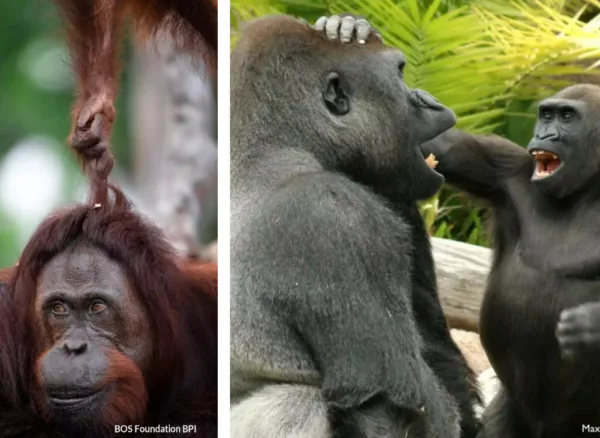
“The study of animal emotions is really in its infancy… There’s a lot of research on fear, on anger, and on grief. And there’s very little research on joy,” says Erica Cartmill, PhD, Professor of Cognitive Science, Animal Behavior and Anthropology at Indiana University Bloomington. Cartmill directs the COMPARE Lab (Comparing Other Minds in Play, Adaptation, Representation, and Emotion), where her team investigates how humans and other animals reason about and communicate with one another. In 2024, she and her collaborators published findings on spontaneous playful teasing in all four great ape species, highlighting a form of complex, joy-related social behavior.
“Victory squeals, warble calls, laughter… these may all be emotional signals, and the idea is that they might actually affect the internal state of other individuals,” explains Heidi Lyn, PhD, Associate Professor and Joan M. Sinnott Chair of Psychology at the University of South Alabama. Her research spans marine mammals, dogs, and apes, focusing on how cognition and communication emerge across species and environments.
Colin Allen, PhD, Distinguished Professor of Philosophy at the University of California, Santa Barbara, studies the philosophical foundations of cognitive science and neuroscience. “Joy is a natural phenomenon,” he says, “and like all natural phenomena, we should be able to study it scientifically.”
The current research centers on three highly intelligent, social species: great apes, dolphins, and kea parrots. Researchers are using tools such as thermal imaging, vocalization analysis, and behavioral observation to investigate how joy might arise in animals, how it spreads, and how it influences behavior. These species were chosen for their intelligence, social complexity, and playfulness, as well as their evolutionary distance from one another. That evolutionary gap helps researchers explore whether and how joy might emerge across very different types of animals.
This work is part of a Diverse Intelligences project supported by TWCF: Joyful by Nature (doi.org/10.54224/33225). The project's goal is to define, detect, and understand joy as a key marker of intelligence.
To effectively investigate animal consciousness and emotions, the scientists first had to establish a working definition of joy that could be observed, measured, and compared across species. They've centered their definition around capturing fleeting yet meaningful bursts of positive affect: emotional responses triggered directly by events or stimuli in the animal’s environment. These are not long-lasting moods but vivid, momentary experiences that can be behaviorally and physiologically tracked.
“We’re looking for short bursts of positive affect,” explains Lyn. These are “moments when something in the environment sparks an emotional reaction,” she says, what Cartmill calls “these ‘aha’ moments, these moments of transformation.”
The research is organized around five key questions. Each is explored using methods tailored to the species being studied, such as cognitive bias testing, vocalization playback, touchscreens, and close behavioral observation. The approach combines behavioral science with comparative philosophy of mind. Bringing philosophy into the lab helps clarify how scientific conclusions are drawn. "Philosophers like myself who work closely with scientists also pay attention to how we make inferences from experiments," says Allen. This interdisciplinary approach makes it possible to ask new kinds of questions and ensures that the work remains rigorous and replicable.
Theme 1: What are the behavioral and vocal signals of joy in animals? The researchers are observing animals both in the wild and in enriched environments to understand when joy appears naturally. For kea parrots, the team is analyzing distinctive “warble” calls, often produced during play or on sunny days. Cartmill notes that the kea parrots "love snow, they love playing in snow,” and that “weather is a significant predictor of when they will produce warble calls in the wild.”
In dolphins, joy may be expressed through “victory squeals” that occur after a successful task or catch. These squeals, Lyn says, are not just signs of exertion. “When the trainer says, ‘You did it, you got it,’ there’s this immediate 'explosion!' Sometimes they leap out of the water, squealing the whole time.”
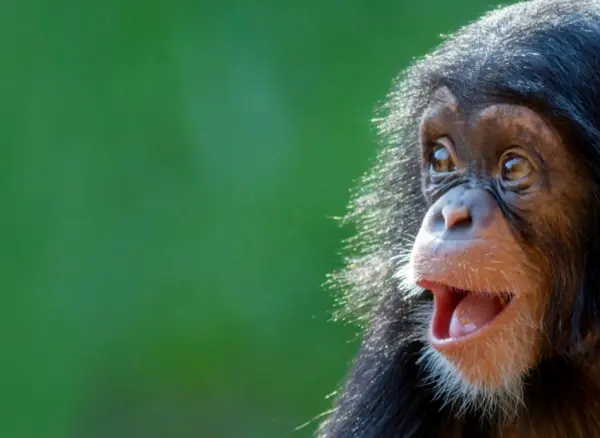
Bonobos also show possible signs of joy, such as laughter during play and social reunions. Cartmill shares early findings that bonobos exposed to recorded laughter appear to behave more optimistically, even in ambiguous situations.
Theme 2: Can joy be elicited through environmental manipulation? The team is exploring whether joy can be intentionally triggered. One method involves a "windfall" task, where animals repeatedly receive a small, predictable reward and then unexpectedly receive a larger one. Bonobos react with excited vocalizations, increased movement, and signs of delight.
“What the windfall hopefully is teaching us is that we can predict and we can elicit positive affect in another species,” Lyn says, “and therefore hopefully we’ve created positive emotion.”
Theme 3: Do joy signals spread to others nearby? The researchers are investigating emotional contagion, i.e., whether joy can be transferred from one animal to another. In one experiment, bonobos are trained to associate black boxes with rewards and white boxes with none. When shown ambiguous gray boxes after hearing recordings of joyful bonobo laughter, the animals are more likely to explore the uncertain option.
Sasha Winkler, PhD, a postdoctoral researcher at the COMPARE Lab, says this may show that animals exposed to joy are “more willing to explore the unknown.”
The researchers are also testing whether animals that hear joyful sounds are more likely to cooperate. Cartmill explains, “We’re also doing some experiments with cooperation tasks… taking an ape who is listening to laughter or a kea who’s listening to a warble call or a dolphin who’s listening to a victory squeal, and asking are they more likely to cooperate with another individual after they’ve heard that?”
Theme 4: Does joy affect cognition? To understand how joy influences thinking and attention, the team is conducting cognitive experiments. In one, bonobos are shown facial expressions on a touchscreen and asked to respond. Daan Laméris, PhD, another postdoctoral researcher at the COMPARE Lab, reports that “preliminary results suggest they respond more quickly to joyful expressions — like play faces — than to neutral or distress-related ones."
Theme 5: How does joy affect social relationships? The researchers are also exploring whether joy enhances cooperation, trust, or prosocial behavior. Animals are first exposed to joyful stimuli — such as laughter, warble calls, squeals, or even tickling in apes — and then observed in social settings or group tasks. Early findings suggest that joy might help strengthen social bonds or reduce conflict.
This research raises important questions about how we understand and relate to other species. It challenges the idea that emotions like joy, empathy, and love are uniquely human. Cartmill suggests that resistance to the idea of animal joy may stem from our desire to maintain a belief in “human uniqueness that we would like to continue to believe in.” Lyn adds, “There’s no question in my mind that humans are unique, but so is every other species.”
Ultimately, says Cartmill, “if we can start to appreciate moments of beauty and meaning and joy in the lives of other species, then we’ll be able to better appreciate them in each other and in ourselves. And that’s certainly something that I hope we will take away from this study: a greater capacity for joy in our own lives.”
Created by TWCF grantee, journalist, and senior media executive Richard Sergay and his team at Rebel Media, the award-winning “Stories of Impact” video series weaves together in-depth interviews, engaging narratives, and critical perspectives to explore scientific discoveries and fresh insights into life’s deepest questions. The videos illuminate the individual and societal impact of research at the intersection of science and spirituality, and serve as a basis for the podcast of the same name. The video series has received multiple honors, including Webby and Gold Telly Awards.