By recognizing joy in other animals, and learning how to encourage it, we may gain not just better science, but a larger capacity for joy and responsibility in our own lives. A team of expert researchers shares why it’s both timely and important to move the science of animal emotion forward.
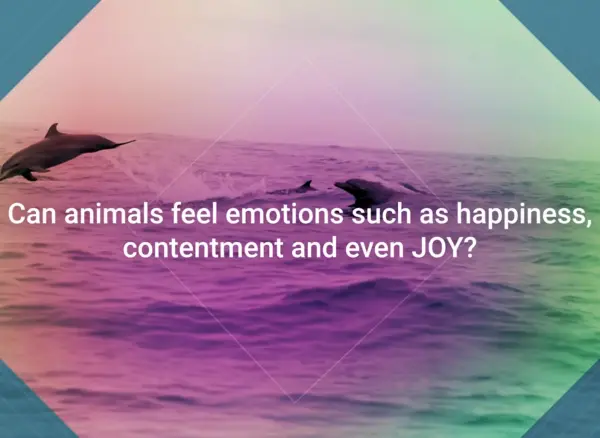
Is joy something uniquely human or a shared emotional thread running across many intelligent, social animals?
In this Stories of Impact podcast episode, researchers Erica Cartmill, Heidi Lyn, and Colin Allen talk about their TWCF-supported project Joyful by Nature and what it means to take animal joy seriously.
Listen with the below player
“There’s a tendency to think about nature as being all about survival, all about nature red in tooth and claw,” says Erica Cartmill, PhD, Professor of Cognitive Science, Animal Behavior and Anthropology at Indiana University Bloomington, where she also co-directs the Center for Possible Minds. But there’s more to life, both human and non-human, than just getting by, says Cartmill. “What we were hoping to really shine a light on and ask deep systematic questions about is what are the experiences that animals have that help fill their lives out, that help give them meaning, that fill their moments with beauty and excitement and give purpose to their lives.”
Cartmill's COMPARE Lab (Comparing Other Minds in Play, Adaptation, Representation, and Emotion) team investigates how humans and other animals reason about and communicate with one another. In 2024, she and her collaborators published findings on spontaneous playful teasing in all four great ape species, highlighting a form of complex, joy-related social behavior.
Her team’s Joyful by Nature project shifts the focus from fear and threat to positive experiences: the playful chaos, the reunions, the “aha” moments that may make an animal’s life feel worth living.
Cartmill’s working image of joy is very concrete. She describes joy as “these ‘aha’ moments, these moments of transformation, of feeling moved, of bursting out of yourself and expressing that positive emotion in a way that’s externally visible and just can’t be contained.”
To make joy scientifically tractable, the team defines it as brief, intense bursts of positive emotion tied to specific events, more like laughter than a long mood. Heidi Lyn, PhD, Associate Professor and Joan M. Sinnott Chair of Psychology at the University of South Alabama, whose research spans marine mammals, dogs, and apes, focusing on how cognition and communication emerge across species and environments, asks a simple question. “How much do we find happiness, joy, positivity generally across animal species? How much is that sort of embedded, ingrained in us as a natural part of being an animal?”
For Lyn, it’s not enough to show animals aren’t suffering: “It can’t just be about the absence of negative emotion. It also should be about the presence of positive emotion.”
Colin Allen, PhD, Distinguished Professor of Philosophy at the University of California, Santa Barbara, connects this to the time-course of laughter: “Laughter is normally this very fast response… the characteristic dynamics of laughter, I think, are rather similar to the characteristic dynamics of this state that we’re interested in that we’re calling joy.” Allen studies the philosophical foundations of cognitive science and neuroscience. “Joy is a natural phenomenon,” he says, “and like all natural phenomena, we should be able to study it scientifically.”
Listen to the episode for more of the scientists' insights about the evolution and the function of joy in animals.
In the podcast, the researchers describe vivid examples from three focal species: dolphins, kea parrots and great apes.
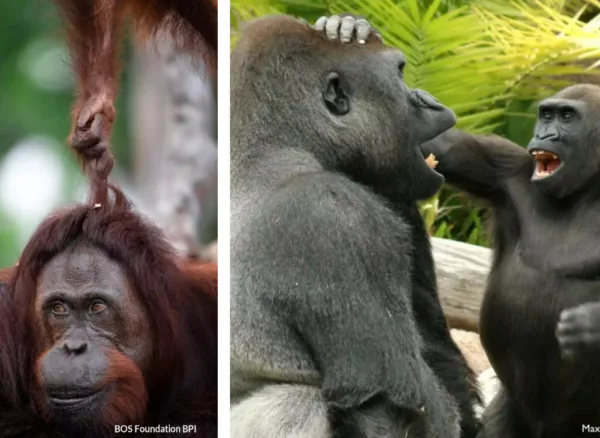
Dolphins produce exuberant “victory squeals” when they finally master a new task. When the trainer signals, “You did it. You got it,” Lyn sees “this immediate sort of explosion,” with dolphins leaping and “squealing pretty much that whole time.” Kea parrots give a distinctive warble call while playing and on bright snowy days they seem to especially enjoy. Hearing that call can prompt other kea to start playing or keep going longer. Great apes laugh while wrestling, grooming, and reuniting after time apart. Cartmill finds adult chimpanzee “pant-laughter” during reunions between close partners “incredibly moving.”
Across all three species, the team pairs these observations with physiological measures — heart rate, pupil dilation, changes in blood flow — to better understand what’s happening internally when joy appears.
Recognizing animal joy has ethical consequences, and studying joy opens a path into big questions about consciousness and human uniqueness. Allen notes that scientific attitudes toward animal minds have shifted. “We’re in a period where people are taking far more seriously the idea that animals are conscious, that they have feelings, that they have thoughts, that they can reason,” he says. He also links joy to learning and education, asking whether “very good events” change how animals — and humans — learn and explore, with implications for how we “bring joy perhaps into the classroom.”
Lyn is frank about what’s at stake ethically: “Our resistance to granting animals the ability to feel positive emotions definitely reflects on us… If we recognize that they can be playful and they can feel joy, do we have to think again about how we treat them?” As she looks ahead, Lyn frames the issue in terms of stewardship. “How do we leave the world better than we came to it,” she asks. “If we can recognize joy in other species and recognize how to encourage it in those species, then we have a real good shot at making the world better.”
Allen connects this directly to responsibilities. He says “as we get a better understanding of what it’s like to be one of these animals, that raises important ethical questions about how one treats those animals.”
For Cartmill, the biggest gift of this work may be a new sense of connection. “I think what it does do hopefully is to give us an appreciation of our place in the universe. It connects us to the natural world. It connects us to other species… If we can start to appreciate moments of beauty and meaning and joy in the lives of other species, then we’ll be able to better appreciate them in each other and in ourselves.”
This work is part of a Diverse Intelligences project supported by TWCF: Joyful by Nature (doi.org/10.54224/33225). The project's goal is to define, detect, and understand joy as a key marker of intelligence.
To learn about the experimental design, five research themes, and early findings of the project, see the related video post: Diverse Intelligences: The Search for Joy in Animals (video)
Find more about Diverse Intelligences here.
Built upon the award-winning video series of the same name, Templeton World Charity Foundation’s “Stories of Impact” podcast features stories of new scientific research on human flourishing that translate discoveries into practical tools. Bringing a mix of curiosity, compassion, and creativity, journalist Richard Sergay and producer Tavia Gilbert shine a spotlight on the human impact at the heart of cutting-edge social and scientific research projects supported by TWCF.