What's possible when schools put character development at the heart of education?
Henry May, teacher-turned-social entrepreneur and founder of Coschool, and Nicole Bruskewitz, Coschool’s Director of Education, join this episode of Stories of Impact podcast.
They share how trauma-informed teaching, social-emotional learning, and the PRIMED model of character education are equipping school leaders, staff, and students in Colombia with the tools to cultivate their inner strengths, build strong relationships, and nurture their communities.
Listen with the below player
Henry May's first experience as a teacher was at “a very challenging inner city public school in South London. One of my students was sent to jail for murder. Another one of my students was murdered,” he shares. “The context of the school was one of a lot of violence and a lot of suffering.” May had shifted his focus to educating educators when he was given an opportunity to design a teach training program in Colombia, and he carried with him the experience of
teaching kids in trauma. In 2013, he became a social entrepreneur, founding the innovative education program Coschool with the idea of helping students and teachers thrive despite adversity.
Part of May's motivation was to challenge a long-standing paradigm that sees education mainly as preparation for exams, qualifications, and the job market: “a very capitalist understanding of education.” As he explains, “When people actually think about the most important parts of their education, they are often the moments where they developed their character. And those character strengths are the reasons they were able to flourish in their job, in their personal life, in their relationships in many senses.” He believes that character is not just a nice-to-have, but the very core of what schools should be doing: “Character development is responsible for so much of life and for so many of the good things that humans do, but also of the less good things that humans do. The absence of good character often leads to terrible suffering, and the presence of good character often leads to humans fulfilling their potential. Developing the whole self, developing character, the development of your academic performance and so on should be the central purpose of education.”
What makes Coschool unique is its ability to bring different communities together. “We connected schools, public schools and private schools. We brought together kids from different backgrounds, teachers from different backgrounds… and found that bringing kids together for collaborative learning was a pretty cool way for young people to learn about themselves, to learn about others, to learn about the world that they were living in, and develop their character strengths,” says May.
Nicole Bruskewitz’s path was equally personal. “I was always really concerned about why some people had access to things in my community that other people didn’t,” she recalls. That curiosity eventually led her into bilingual education, where she taught immigrant children in Chicago and saw firsthand the barriers they faced. “The biggest obstacle to learning is not the subject,” she explains. “It’s the emotional content and it’s what the human beings are going through in their lives that permit them to learn or not.”
Her years in Chicago schools and later as a university professor in Colombia confirmed this insight: teachers have to wear many hats, “psychologists, nurses, mothers, friends,” to support students’ full development. That realization inspired her to leave language teaching and take on social-emotional education at Coschool. “I jumped ship from a very cushy job in academia to work in a social enterprise,” she says, “not for the money and the perks, but for the cause: promoting human flourishing, that is really at the heart of my purpose as a teacher.”
Bruskewitz further shares, “Character development as it relates to education has to do with nurturing human goodness. It is the most beautiful part of being an educator. You have a human being in front of you, and I believe deeply that every single human being has something to offer to the world, and they have a talent and they have beauty inside them, and they have a seed of goodness that needs nurturing. Just like the task of being an educator is like being a gardener. How do you give that seed the soil it needs, the water it needs, the sunlight it needs to germinate and flourish in the end?”
The PRIMED Model
In 2018, Coschool adopted Dr. Marvin Berkowitz’s PRIMED model for character education, which integrates evidence-based principles of character virtue development, grounded in decades of research on educational psychology and moral development. “The most important thing to understand about the PRIMED model is that it's a collection of principles. It's not a dogma. It's not a recipe. It's not a methodology,” says May. “They're principles to guide the design or redesign of schools so that schools become places where children flourish.”
The six principles PRIMED is bulit around are:
With TWCF backing, May and Bruskewitz led a pilot project to bring PRIMED into 10 public schools in Bogotá, each serving around 2,000 students. Their work began with school leaders, guiding them through deep reflection on their own character and leadership practices before extending the model to teachers and students. Over time, schools reported cultural shifts: safer, more inclusive climates; student mentors supporting younger peers; and children resolving conflicts through dialogue rather than violence.
Bruskewitz notes that while examples and language were adapted for Colombia, “the notions and the ideas that are at the heart of the model really do work here because I really do think that human character does have a lot of universal ingredients that are not particular to language or culture.”
In a country marked by inequality and conflict, character education helps heal wounds. Practices like emotional check-ins, restorative justice circles, and peer mentoring are fostering empathy and resilience. These approaches build what May calls “conditions in which each student can flourish from their particular virtue and the particular good that they have to bring to the world.”
May and Bruskewitz envision character education becoming a systemic commitment in Colombia and beyond, showing how schools can move from transactional instruction to nurturing whole persons. By prioritizing character virtue development, schools can cultivate not only stronger students but stronger communities.
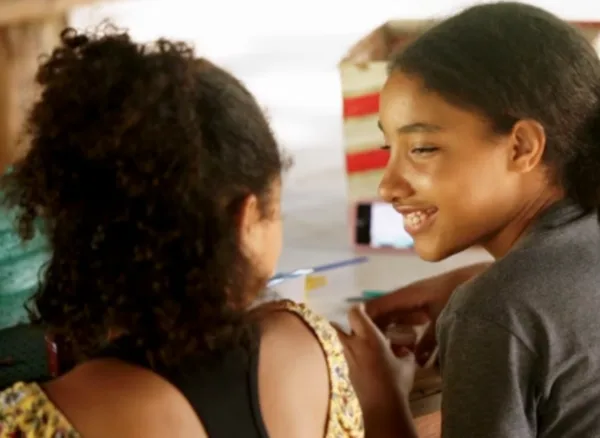
Picture above: Courtesy Coschool
Built upon the award-winning video series of the same name, Templeton World Charity Foundation’s “Stories of Impact” podcast features stories of new scientific research on human flourishing that translate discoveries into practical tools. Bringing a mix of curiosity, compassion, and creativity, journalist Richard Sergay and producer Tavia Gilbert shine a spotlight on the human impact at the heart of cutting-edge social and scientific research projects supported by TWCF.