The transformative power of forgiveness and art illuminates a pathway to healing in Post-Genocide Rwanda.
In this episode of SongWriter podcast, Freddy Mutanguha, CEO of Aegis Trust, describes his story of surviving the Rwandan genocide and his journey toward forgiveness, alongside poems by Hope Azeda, music by Peace Jolis and Ben Arthur, and insights from forgiveness researcher Pamela Wadende.
Listen with the below player
"Season 6 of SongWriter Podcast is made possible by a grant from Templeton World Charity Foundation and is oriented around elements of human flourishing. As part of this work with Templeton, I was invited to take part in a conference in Kigali, Rwanda. I knew if I would be there, I'd want to record an episode, but I wasn't at all sure where to start. When I had an opportunity to meet Freddy Mutanguha, when he was in New York City for a few days, I jumped at the chance."
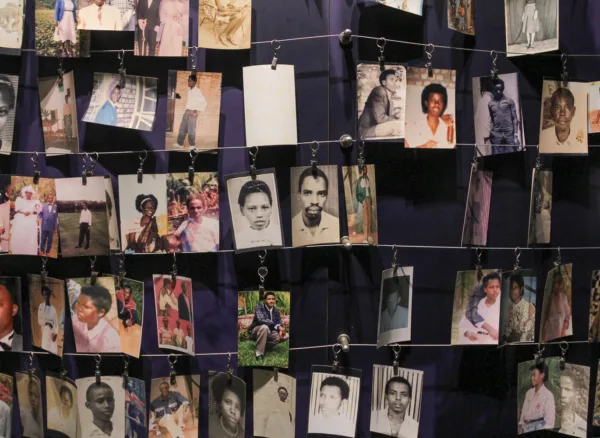
Freddy Mutanguha is CEO of Aegis Trust, the organization behind the Kigali Genocide Memorial, where more than 250,000 victims are honored.
"When we met, I asked Freddy who the Rwandan author or storyteller was that I should invite to take part and he immediately said, "Hope Azeda." With that settled, I invited Freddy to dinner at my house if he had time while he was in town. It was only as I was cooking dinner that night that I realized I needed to interview Freddy as well. So when he arrived, I asked and he agreed. A few days later, I sent an edited version of the interview to Hope who sent me in return some related poems. Hope and I decided to mix these poems in with Freddy's story and I added some music as well.
Before you hear it, it is worth acknowledging that Freddy's story is upsetting and at times horrifying and violent. But it is also an incredibly important story to hear. When Freddy and I spoke, I remember being very concerned that I was asking him to tell a story that was too hard, something that he would not want to relive. I now believe this was a fundamental misunderstanding. When I was in Rwanda, I was repeatedly asked by Rwandans to tell this story and others like it. As you'll hear, telling and retelling these stories is an important part of healing and a way to create meaning and purpose for the living and the dead."
In the episode, Mutanguha shares the personal details of his traumatic experiences, including losing his mother, stepfather, and many relatives during the genocide — often perpetrated at the hands of neighbors and people he knew.
“The people who came to attack our house, they were people we knew,” Mutanguha says. “They were our neighbors. The person who took out from our house my mom, actually was her student.”
Mutanguha openly discusses the challenge of forgiveness, highlighting the complexities of overcoming hatred and bitterness after such profound trauma. He also notes the importance of leading by example, for his children, for his country, and future generations:
“I forgive so that I can live in peace. The forgiveness is my advantage... My choice is to forgive them so that I can live without anger, without hatred in my heart. And then so that we can live with my children without transmitting this anger and hatred to them,” he shares in a video clip.
Mutanguha reflects on how significant moments in his life — his wedding, the birth of his children — can awaken the pain of loss, making his decision to forgive all the more meaningful:
“I learned not to be imprisoned by the past, but also to remember it, consider it, and embrace the life of the future. I want to be who my mom asked me to be.”
Mutanguha also emphasizes the importance of gradually sharing the difficult truths of his past with his children, using honesty and hope to foster understanding and resilience. He describes storytelling as essential to breaking the cycle of violence and promoting reconciliation in Rwanda.
Dr. Pamela Wadende, a forgiveness researcher from Kenya, says sharing stories, acceptance and honesty are key rituals of forgiveness. She participated in the podcast’s live performance in Kigali. Dr. Wadende’s research spans indigenous forgiveness rituals and practices across communities in Kenya, Cameroon, Zambia, and Ethiopia. She emphasizes that authentic healing extends beyond individual survivors to encompass entire communities, including the reintegration of perpetrators:
"Effective community justice practices help people engage with forgiveness and healing and, crucially, help reintegrate perpetrators into the community. These local practices — distinct from state-level justice — are key to ending cycles of revenge and violence."
Reflecting on Mutanguha’s openness, Dr. Wadende observes:
"When I listened to Freddy’s story, I’m looking at this person who is on the journey of healing, who is actually healed. The scars inside their heart have healed. You can touch that scar — they remember vividly what happened — but it’s not as painful as it was when they started."
During the live performance, art activist and author Hope Azeda, whose own family was also deeply impacted by the genocide, shared poems she wrote about talking to children about the genocide. The poems are written from the perspective of her mother, and explore the profound challenges of Rwandan parents.
During the genocide, militia chanted slogans and sang to incite violence. But now, explains Azeda, it's important to reclaim the power of art, and use it along the journey towards reconciliation, healing, and human flourishing.
"We know that also art can heal, and we've been using art also as a tool to transform — to transform societies, to create pathways, to create spaces of empathy where people feel safe to heal or create spaces where people can even be able to just, you know, feel not lonely, feel like oh you went through this, I also went through this," she says in this video clip. "There's a space of empathy where people feel like there is some level of care in art, so it comes with that layer of care, I'm not just performing but I'm also taking care of you. I'm receiving your story as a gift and right now in this moment I am giving it back as a gift. That's the same thing I felt with Freddy when I listened to his story — like he had given me his story as a gift and I had to respond the same way."
Musician Peace Jolis was three years old during the genocide and survived by hiding in the bushes with his mother and grandmother for months, but hardly remembers it because he was so young. In the above video clip he explains how protective his mother was about it. She didn’t tell him the full story of their survival until he was seventeen. At the live performance, he contributed the song "BAHO," which means "live" in Kinyarwanda. The song integrates Mutanguha’s mother's final words— "Be a man, go and live" — as an anthem of hope, resilience, and healing.
Arthur also composed a musical response, titled "Kigali," and performed live alongside Peace Jolis at the event. Listen to that song and find a full account of live performance on the SongWriter website.
Find highlights from the related Aegis Three Day Conference: "Listening and Leading: The Art and Science of Peace, Resilience, and Transformational Justice" in the below video.
SongWriter turns stories into songs. It is an exploration of inspiration delivered in the form of a podcast and related live performances, digital and print media, radio, and social media. Guests are paired by creator and host of SongWriter, Ben Arthur.
Podcast episodes supported by Templeton World Charity Foundation explore themes of human flourishing. Each of these features a storyteller or author who tells a story on the episode's theme, a scientist who explains the underlying mechanics and associated research, and a songwriter who performs a song written in response.