What role could religion have in developing ethical frameworks around technology?
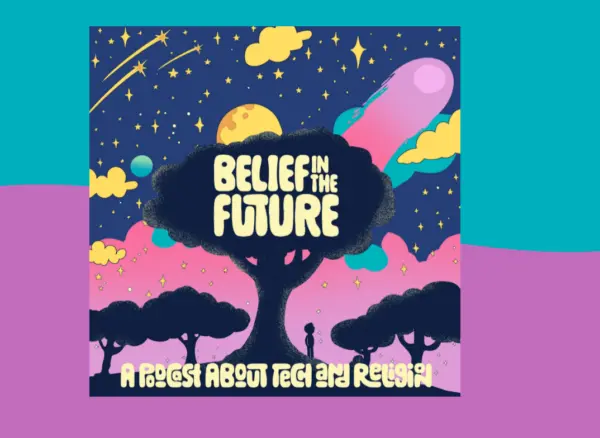
Rabbi Zvika Krieger, Spiritual Leader of Chochmat HaLev, a progressive spiritual community in Berkeley, CA, and former Director of Responsible Innovation at Facebook joins host David Zvi Kalman in this episode of Belief in the Future podcast. They discuss the Metaverse, how religious leaders can lean into technology, and what separation of tech and religion could look like.
Listen with the below player
How will technology change religion? Should religion play a role in ethically guiding technology? These two questions are at the core of the conversation.
Rabbi Zvika Krieger — once Facebook’s Director of Responsible Innovation, and now a San Francisco Bay Area spiritual leader — has lived at the intersection of spirituality and technology. “I used to see my tech work and my rabbinic work as two separate parts of my persona,” he says. “But it’s hard to keep your personas separate in the internet age.” Colleagues started jokingly calling him “the Facebook rabbi,” as he helped teams navigate ethical trade-offs in product design. “I wasn’t there to give a kosher stamp,” he says. “It was my job to help people connect to their own internal compass.”
The idea of religion being involved with tech makes people uneasy because, as Kalman puts it, “religious groups have a track record of providing their moral compasses by forcing it on other people.” Krieger acknowledges the discomfort, adding, “Judaism is great at presenting debates, not conclusions… It’s not really great for prescriptive thinking.”
Despite this, Krieger sees religion playing a valuable role as “a social force,” able to gather people around shared norms and community. “Judaism has incredible tools for framing decisions, but not necessarily for making them.” Citing the Talmud’s inclusion of minority opinions, he notes that “Judaism thrives on debate, not answers.”
When the conversation turns to virtual reality (VR) and the Metaverse, Krieger sees both danger and promise. Looking forward, Krieger urges religious communities to actively engage new tech spaces like the Metaverse. “Ask any 10-year-old — the Metaverse is already here,” he says. “Religious leaders can either be left behind or become early innovators.” He imagines future synagogues that lend out VR headsets like old-school arcades, giving people immersive, spiritually resonant experiences. “It’s not about copying real life — it’s about creating something better.”
“We actually have an opportunity to recreate the world," he emphasizes. “Technology can help get us closer to…a utopian, idealist future, but of course it also has the possibility of exacerbating the things preventing us from reaching that.” The challenge for religious communities is whether they’ll step forward — not to control technology, but to shape its meaning.
Tune in to the full episode with the above player to hear more and view show notes here.
Learn about Templeton World Charity Foundation's Science of Religious and Spiritual Exercises.
"Technology and religion sometimes seem like oil and water, but they've been crossing paths for centuries and aren't going to stop," says Belief in the Future podcast host, David Zvi Kalman. Belief in the Future explores the ethical, social, and existential implications of transformative new technologies — like AI — through creative conversations at this crucial intersection. The podcast is produced by Sinai and Synapses, with support from Templeton World Charity Foundation.